Quick answer
ProDentim is an oral-probiotic chewable with modest adjunct evidence from published randomized trials on its key strains, notably Lactobacillus reuteri. Steel Bite Pro is a 23-ingredient herbal capsule with weaker ingredient evidence and a serious clone-site consumer risk. Neither has an independent finished-product trial, neither cures gum disease, and both offer a 60-day money-back guarantee only through verified official sources. For most readers, ProDentim's strain-level research is easier to evaluate than Steel Bite Pro's broad herbal blend.
- ProDentim's key strains appear in published trials showing modest adjunct benefit, though evidence quality is low
- Steel Bite Pro has no finished-product trial, and its distribution has spawned many knockoff and clone sites
- Neither supplement cures gum disease; both are at best modest add-ons to professional care
Short on time? Our pick
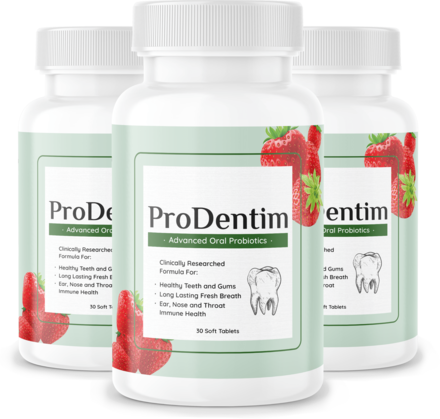
ProDentim
Oral probiotic chewable
Our editorial score.Scored on formulation, refund policy, and value, not on a proven cure.
The best-known oral-probiotic chewable, and a reasonable second choice if you prefer a lozenge.
- 60-day money-back guarantee, which covers the trial period if it does not help
- Chewable format some people stick with more easily than capsules
- Sold through BuyGoods, which processes refunds reliably
No independent trial shows ProDentim reduces gum disease. We rank it just below ProvaDent on formulation, and the 60-day refund window is the only thing that makes a trial reasonable.
ProDentim is an oral probiotic chewable built around specific bacterial strains; Steel Bite Pro is a 23-ingredient herbal capsule blend sold via ClickBank. Neither has an independent clinical trial of the finished product. ProDentim’s probiotic strains have at least modest adjunct evidence from published research; Steel Bite Pro’s herbal ingredients have weaker, mostly lab-level support and a serious consumer-facing problem: a large ecosystem of knockoff and clone sites that can make it hard to buy the genuine article.
The short answer
If the choice is between these two products, ProDentim has a narrower but more traceable evidence chain. Its key strain, Lactobacillus reuteri, appears in randomized trials as an adjunct to gum treatment, and a 2025 meta-analysis found a small, significant benefit on gum bleeding and plaque when oral probiotics are added to professional care. Steel Bite Pro’s 23-ingredient herbal blend has no equivalent published research on the finished formula, and the clone-site problem adds a real purchasing risk. Neither product cures gum disease. Neither replaces professional care. Both offer a 60-day money-back guarantee if you buy from a verified source.
What each product is
ProDentim is a soft chewable tablet containing approximately 3.5 billion CFU across several probiotic strains, including Lactobacillus reuteri, Lactobacillus paracasei, Bifidobacterium lactis BL-04, BLIS K-12, and BLIS M-18. It also contains inulin as a prebiotic, tricalcium phosphate, malic acid, and peppermint. It is positioned as a daily oral microbiome supplement.
Steel Bite Pro is a capsule described by its seller as a 23-ingredient herbal blend. Stated ingredients include milk thistle, beetroot, artichoke, dandelion root, chicory root, yarrow, jujube seed, berberine, red raspberry, grape seed extract, and zinc among others. It is distributed through ClickBank, meaning it is primarily sold through affiliate marketers rather than a conventional retail or direct-to-consumer model.
How the evidence compares
| Factor | ProDentim | Steel Bite Pro |
|---|---|---|
| Product type | Oral probiotic chewable | 23-ingredient herbal capsule |
| Key ingredients | L. reuteri, L. paracasei, BL-04, BLIS K-12, BLIS M-18 | Berberine, zinc, milk thistle, grape seed, herbal blend |
| Strain/ingredient trials | Yes, for L. reuteri specifically (adjunct RCTs) | Mostly in vitro or animal models for individual herbs |
| Independent trial of the finished product | No | No |
| Evidence quality | Low (per GRADE rating in the 2025 meta-analysis) | Very low to none for the formula as sold |
| Distribution | Direct-to-consumer (official site) | ClickBank affiliate network |
| Clone/knockoff risk | Low | High (documented ecosystem of imitation sites) |
| Money-back guarantee | 60 days (official source) | 60 days (official source only; not on third-party sellers) |
| Cures gum disease | No | No |
The evidence behind oral probiotics
The case for ProDentim rests on strain-level research, not product proof. A 2024 systematic review found that adding Lactobacillus reuteri to scaling and root planing produced modest improvements in periodontal pocket depth and clinical attachment, based on 11 randomized trials covering 369 subjects. A broader 2025 meta-analysis of 24 trials found statistically significant but small improvements in plaque and gum bleeding when oral probiotics were added to professional care, and rated the certainty of that evidence as low.
Two things to hold onto from those numbers. First, every positive study tested probiotics as an add-on to professional cleaning, not as a standalone treatment. The NIDCR is clear that managing gum disease requires professional care; a supplement does not change that. Second, “statistically significant” and “clinically meaningful” are different thresholds. The effects found in these trials are real but modest: sub-millimeter pocket changes and small reductions in gum bleeding. They are not transformations.
No independent trial of ProDentim as a branded, finished product has been published. The strain research transfers at best as supportive but indirect evidence.
The evidence behind Steel Bite Pro
Steel Bite Pro’s ingredients are harder to evaluate because there are 23 of them and no trial of the combination. Berberine has documented antimicrobial properties in lab studies. Zinc appears in the ADA’s oral health guidance as a micronutrient with some relevance to canker sore history. Grape seed extract and red raspberry contain antioxidant polyphenols that may protect connective tissue in cell culture. But “the ingredient has an interesting lab result” is a long way from “the supplement works in a human mouth.”
No published randomized trial tests Steel Bite Pro’s 23-ingredient formula in patients with gum disease. The absence of a finished-product trial is a fact, not a marketing critique. It is the same gap that exists for ProDentim, but ProDentim’s probiotic strains have more human clinical data to anchor the conversation.
The clone-site problem with Steel Bite Pro
This deserves its own section because it is a practical consumer risk that goes beyond ingredient evidence.
Steel Bite Pro is distributed through ClickBank, which means affiliates earn commissions by promoting it. A large number of websites now use the Steel Bite Pro name to sell knockoff or unverified formulas, running rotating discount pages, counterfeit labeling, and fabricated testimonials. Multiple consumer-facing reviews document this pattern. The 60-day guarantee applies only to purchases through the verified official channel; buying through an unauthorized third-party seller risks receiving a counterfeit product with no refund path.
This is not unique to Steel Bite Pro among ClickBank-distributed supplements, but the volume of clone sites around this particular product is notable. If you choose to try Steel Bite Pro, verifying the source carefully before purchase is essential.
What neither product can do
Both products are sold with language about supporting gum health, fresher breath, and a cleaner oral environment. Neither can cure gum disease, reverse periodontitis, regrow lost tissue, or replace the mechanical work of brushing, flossing, and professional cleaning. The NIDCR states that controlling gum infection requires professional care, and no supplement overrides that. Supplement companies are not permitted to claim their products treat or cure disease, and statements about “supporting” oral health do not carry the same meaning as clinical proof of benefit.
Bottom line
ProDentim is an oral probiotic with modest, low-grade adjunct evidence from published trials on its key strains. Steel Bite Pro is a 23-ingredient herbal blend with weaker ingredient evidence and a significant clone-site consumer risk. Neither has an independent finished-product trial. Neither cures gum disease. Both offer a 60-day money-back guarantee if you buy through a verified source, which is what makes either worth trying at all. If you are choosing between the two, ProDentim’s strain-level research gives you something real to evaluate, while Steel Bite Pro’s formula evidence is thin and its purchase environment is more hazardous. In both cases, the highest-value move for your gum health remains professional cleaning and daily brushing and flossing, with any supplement sitting strictly on top of that.
Related notes
The bottom line
No independent trial shows ProDentim reduces gum disease. We rank it just below ProvaDent on formulation, and the 60-day refund window is the only thing that makes a trial reasonable. If you decide to try one, ProDentim is the option we would pick, mainly because the 60-day money-back guarantee makes a trial risk-free.
Check ProDentim Price for ProDentimFrequently asked questions
Is ProDentim better than Steel Bite Pro?
ProDentim has a clearer evidence base because it relies on specific probiotic strains, notably Lactobacillus reuteri, that have been studied in randomized controlled trials as adjuncts to gum care. Steel Bite Pro is a 23-ingredient herbal blend whose individual ingredients have antioxidant or antimicrobial properties in lab research, but the combination formula has not been tested in any independent clinical trial. Neither product cures gum disease, and both carry a 60-day money-back guarantee. For most readers, the modest strain-level research behind ProDentim is easier to evaluate than the broad herbal blend in Steel Bite Pro.
Does Steel Bite Pro actually work?
There is no independent published trial of Steel Bite Pro as a finished product. Some of its individual ingredients, such as berberine and zinc, have small amounts of research suggesting antimicrobial or anti-inflammatory properties, but combining 23 ingredients does not add up to clinical proof for the formula as sold. Anecdotal reviews are mixed, and the product's ClickBank distribution channel has led to a significant ecosystem of clone sites and knockoffs, which is the main consumer risk.
Are there risks in buying Steel Bite Pro?
The main documented consumer risk with Steel Bite Pro is the clone-site problem. Because the product is sold via ClickBank and is widely promoted by affiliates, a large number of imitation or copycat websites use the Steel Bite Pro name to sell unverified formulas. Buying from an unofficial third-party marketplace risks receiving a counterfeit product not eligible for the official refund policy. The 60-day guarantee applies only to purchases through the verified official channel.
Can either supplement replace professional dental care?
No. Neither ProDentim nor Steel Bite Pro can replace brushing, flossing, and professional cleaning. The NIDCR states clearly that only a professional cleaning can remove tartar, and every clinical study of oral probiotics tests them as an add-on to, never a substitute for, standard periodontal care. Both products are at best modest supplements to a solid daily routine.
Do ProDentim or Steel Bite Pro have clinical trials?
Neither has an independent clinical trial of the finished product as sold to consumers. ProDentim's probiotic strains, particularly Lactobacillus reuteri, have been studied in multiple randomized trials as adjuncts to gum treatment. Steel Bite Pro's herbal ingredients have individual studies, mainly in vitro or animal models, but the 23-ingredient combination formula has no published independent trial.
Sources & references
Every claim above is drawn from these primary sources.
- ● Oral probiotics and periodontal parameters - meta-analysis · PMC (National Library of Medicine)
- ● Probiotics as an adjunct to scaling and root planing - systematic review · PubMed (National Library of Medicine)
- ● Lactobacillus reuteri reduces gingival bleeding - randomized trial · PubMed (National Library of Medicine)
- ● Gum Disease (Periodontal Disease) · NIDCR (National Institutes of Health)
- ● Nutrition and Oral Health · American Dental Association
Free checklist
The 12 checks to run on a gum supplement label before you pay for it.
A one-page checklist drawn from ADA, Cochrane Oral Health and NIH/NIDCR guidance, plus the FTC's own rules on supplement advertising. It tells you which label claims mean something, which are decoration, and the wording that signals a product is not worth your money. We send it immediately, then one short note a week.
One click to unsubscribe. We never sell or share your address. Privacy.