Quick answer
Most dental supplements are real products, not non-delivery scams, but they are routinely sold with cure claims that the evidence does not support. The single clearest red flag is any promise to reverse gum disease, regrow teeth, or replace professional dental care, because periodontal bone loss cannot be undone by a pill. Buying only guarantee-backed products with modest expectations is the safest approach.
- Cure and reversal claims are the defining red flag in dental supplement ads
- Most popular dental supplements are real but oversold, not fake
- A money-back guarantee is the only concrete consumer protection in this category
Short on time? Our pick
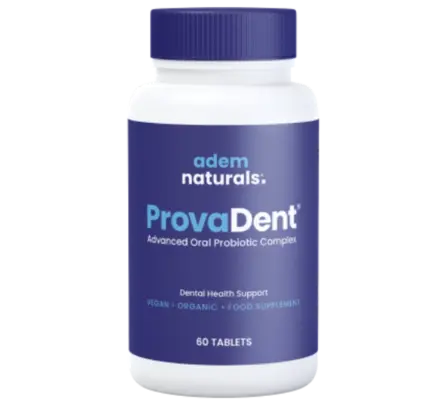
ProvaDent
Oral probiotic support
The oral-health supplement we'd try first, if we were going to try one.
- 60-day money-back guarantee, so a trial costs you nothing if it does not help
- Sold through BuyGoods, which processes refunds reliably
- Aimed at the oral microbiome, the current focus of gum-health research
No supplement is proven to cure gum disease or regrow bone. We highlight ProvaDent for its formulation and guarantee, not as a cure.
If you are wondering whether a dental supplement is a scam, here is the rule that cuts through every sales pitch: no supplement cures gum disease, so any pill that promises to reverse periodontitis, heal your gums, or regrow teeth is making a claim that cannot be true. That single test catches most of the deception in this market, and it works no matter which brand is on the bottle.
The short answer
Most popular dental supplements are not scams in the criminal sense. You order a product, a real product arrives, and most carry a money-back guarantee. The deception is in the marketing, not the shipping box. The products are real-but-overhyped: a genuine probiotic or vitamin blend wrapped in cure-and-transform language that the evidence does not support.
So the useful question is not “is this brand a scam.” It is “which specific claims in this ad are false.” Once you can name the false claims, you can buy the real product with realistic expectations, or walk away entirely.
Why “cure” is the red flag, not the product
Gum disease has a physical reality. In its advanced form, periodontitis, the bone and tissue that hold your teeth in place are damaged, and that bone loss is not reversed by swallowing a capsule. The NIDCR describes gum disease management through professional cleaning and care, not through supplements. The CDC notes that roughly 42% of adults over 30 have some form of periodontitis, a huge and worried audience for anyone selling a quick fix.
That is why any product promising to “reverse gum disease,” “regrow gums,” or “rebuild teeth” is making a physiologically false claim. It is not a matter of the dose being too low or the brand being unknown. The mechanism does not exist. When you see that promise, you have found the red flag, and the brand attached to it almost does not matter.
The dental supplement red-flag checklist
Run any product or ad through this list. The more boxes it ticks, the more the marketing has outrun the evidence.
- Cure or reversal claims. “Reverses gum disease,” “heals periodontitis,” “regrows teeth or gums.” No supplement does this.
- Replacement claims. Anything implying you can stop brushing, flossing, or seeing a dentist. Probiotics are studied as add-ons to cleaning, never as replacements.
- A finished-product trial that does not exist. The ad cites “clinical studies,” but those studies are of individual ingredients, not the actual product. Ingredient research is not product proof.
- Manufactured urgency. A countdown timer, “only X bottles left,” or a price that collapses only if you buy six bottles in the next ten minutes.
- The silenced-insider story. A dentist who “discovered” a secret the industry wants buried, told through a long video you cannot skip or read at your own pace.
- No real refund mechanism. A guarantee that is hard to find, vaguely worded, or routed through a support channel that does not answer.
A product can be legitimate and still tick the first or third box because of how it is marketed. That is the real-but-overhyped pattern, and it describes most of this category.
Real-but-overhyped: what that actually means
Take the two most-searched names, ProDentim and ProvaDent. People ask whether each is a scam, and the honest answer for both is the same: not a scam in the deliver-nothing sense, but oversold.
Both are real oral probiotics. Both ship with a 60-day money-back guarantee, so the financial downside of a trial is bounded. Neither has an independent clinical trial of the finished product, and the strain research behind them shows only a modest, short-term adjunct effect on plaque and gum bleeding that fades after you stop. So the product is genuine, the modest benefit might be genuine, and the cure narrative around it is not. You can hold all three of those facts at once.
What dental supplements can and cannot do
| Claim | Reality |
|---|---|
| ”Cures or reverses gum disease” | False. Periodontal bone loss is not reversed by a supplement. |
| ”Regrows teeth or gums” | False. No supplement does this. |
| ”Replaces brushing and dentist visits” | False. Probiotics are studied as add-ons to cleaning. |
| ”Modestly helps plaque or gum bleeding as an add-on” | Plausible. Small, short-term signal in studies; reverts after stopping. |
| ”Corrects deficiency-related bleeding gums” | True for genuine vitamin C deficiency, where correcting the deficiency helps. |
The honest middle ground is narrow but real: a modest adjunct effect and genuine deficiency correction. Everything above that line is marketing.
How to buy without getting burned
If you decide to try something anyway, protect yourself with a few simple rules. Buy only products with a clear, time-bound money-back guarantee, and keep your order confirmation so you can actually use it. Treat the supplement as an add-on to brushing, flossing, and professional cleaning, never a substitute. And if your gums bleed or hurt, see a dentist, because bleeding gums can signal real gum disease that a supplement will not fix.
Bottom line
The dental supplement market is less full of outright scams than it is full of real products sold with unreal promises. The clean test is the cure claim: no supplement reverses gum disease or regrows teeth, so that promise marks the line between honest and dishonest marketing. Buy with a guarantee, keep your expectations modest, keep your dentist in the loop, and you can navigate this category without getting burned.
Related notes
The bottom line
No supplement is proven to cure gum disease or regrow bone. We highlight ProvaDent for its formulation and guarantee, not as a cure. If you decide to try one, ProvaDent is the option we would pick, mainly because the 60-day money-back guarantee makes a trial risk-free.
Check Latest Price for ProvaDentFrequently asked questions
Is ProDentim a scam?
ProDentim is a real product with a 60-day money-back guarantee, so in the strict sense of receiving nothing, it is not a scam. The problem is the marketing. No oral probiotic, including ProDentim, has an independent clinical trial of the finished product, and no supplement can cure gum disease. So the product is real-but-overhyped: you get a genuine probiotic, but the cure-and-transform language around it goes far beyond what the evidence supports. Judge it by its guarantee and modest expectations, not by the sales video.
Is ProvaDent a scam?
Like ProDentim, ProvaDent is a real product with a 60-day money-back guarantee, so it is not a scam in the sense of delivering nothing. It is an oral probiotic with no independent trial of the finished formula, which means the honest expectation is a modest adjunct effect at best, not a cure. The red flag to watch is not the product existing, it is any claim that it reverses gum disease or regrows teeth, because no supplement can do that.
What is the biggest red flag in a dental supplement ad?
The single biggest red flag is a cure or regrowth claim: any promise to reverse gum disease, heal periodontitis, regrow gums, or rebuild teeth. Periodontal bone loss is not reversible with a pill, so these claims are physiologically false regardless of which product makes them. Other strong red flags include a fake countdown timer, a long video you cannot skip or read, a secret dentist or insider being silenced, and pricing that drops dramatically only if you buy multiple bottles right now.
Are dental supplements ever worth buying?
Sometimes, with the right expectations. Oral probiotics show a modest, short-term adjunct benefit for plaque and gum bleeding in studies, and correcting a real vitamin C deficiency genuinely stops deficiency-related bleeding gums. So a guarantee-backed probiotic can be a reasonable bounded experiment alongside good hygiene. What is never worth buying is the promise that a supplement replaces brushing, flossing, and professional cleaning, or that it cures gum disease.
Sources & references
Every claim above is drawn from these primary sources.
- ● Gum Disease (Periodontal Disease) · NIDCR (National Institutes of Health)
- ● Periodontal Disease in Adults · Centers for Disease Control and Prevention
- ● Oral probiotics and periodontal parameters - meta-analysis · PMC (National Library of Medicine)
- ● Gum disease · NHS UK
- ● Nutrition and Oral Health · American Dental Association