Quick answer
ProvaDent contains a probiotic blend (3.5 billion CFU, strains not publicly named on the official page), organic xylitol, cranberry extract, purple carrot powder, and a proprietary enzyme blend called BioFresh Clean Complex. Oral probiotic strains as a category have modest published evidence as an adjunct for gum bleeding and plaque, but specific strains are undisclosed, and no independent clinical trial of the finished ProvaDent formula exists. Supporting ingredients like cranberry and purple carrot have only preliminary or in-vitro evidence.
- The official product page does not name the specific probiotic strains; L. reuteri or BLIS K-12 claims come from third parties
- Oral probiotic strains have modest, low-quality evidence as an add-on, not as a standalone treatment
- Cranberry extract, purple carrot powder, and the proprietary enzyme blend have no published human trials in this format
Short on time? Our pick
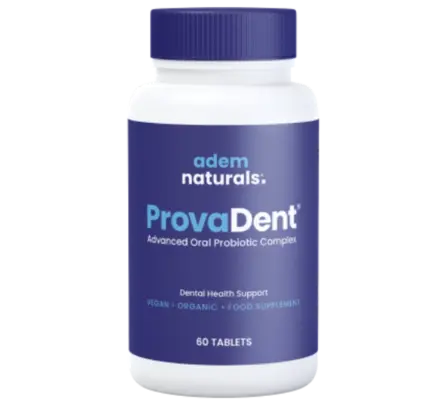
ProvaDent
Oral probiotic support
Our editorial score.Scored on formulation, refund policy, and value, not on a proven cure. No gum-disease supplement is clinically proven.
The oral-health supplement we'd try first, if we were going to try one.
- 60-day money-back guarantee, which covers the trial period if it does not help
- Sold through BuyGoods, which processes refunds reliably
- Aimed at the oral microbiome, the current focus of gum-health research
No supplement is proven to cure gum disease or regrow bone. We highlight ProvaDent for its formulation and guarantee, not as a cure.
ProvaDent is an oral-probiotic capsule whose official product page lists four main ingredient categories: a probiotic blend (3.5 billion CFU across multiple strains), organic xylitol, cranberry extract, purple carrot powder, and a proprietary enzyme blend called the BioFresh Clean Complex. The specific probiotic strain names are not disclosed publicly on the official site. This page walks through each ingredient category, what the published science says about it, and where the honest gaps are.
The short answer
ProvaDent contains real ingredients that each have at least some plausible scientific rationale for oral health. The problem is that the evidence is mostly modest or preliminary, specific strains are undisclosed, and no independent trial of the finished ProvaDent product has been published. What you are buying is based on ingredient-category research, not product proof.
What is actually listed on the official product page
When this article was researched in June 2026, the official ProvaDent product page listed these ingredients:
| Ingredient | What it is | Claimed role |
|---|---|---|
| Probiotic blend | Multiple strains, 3.5 billion CFU total (strains not named) | Support a balanced oral microbiome |
| Organic xylitol | Sugar alcohol from non-GMO corn | Reduce plaque-forming bacteria |
| Cranberry extract | Proanthocyanidin-rich botanical | Antibacterial, anti-adhesion |
| Purple carrot powder | Anthocyanin and chlorogenic acid source | Antioxidant support for oral tissues |
| BioFresh Clean Complex | Proprietary enzyme blend | Biofilm control |
The probiotic strains are not named on the official product site. Some third-party review pages mention L. reuteri and BLIS K-12, but those names do not appear on the official page reviewed for this article. The analysis below covers those named strain types because they are the most commonly associated with oral-probiotic formulas and have the best-published evidence, but if strain transparency matters to you, check the physical label you receive.
Oral probiotic strains: the ingredient category with the best evidence
Among the ingredients in a formula like ProvaDent, oral probiotic strains carry the strongest published evidence base, even if that evidence is still modest overall.
Lactobacillus reuteri is the most studied strain for gum health. A foundational randomized controlled trial found L. reuteri significantly reduced gum bleeding and plaque in patients with moderate to severe gingivitis over two weeks. A 2025 comprehensive review of L. reuteri confirmed it can reduce pro-inflammatory cytokines and pathogenic bacteria when used alongside scaling, while also flagging that results are inconsistent across populations and that long-term safety is not well studied.
BLIS K-12 (Streptococcus salivarius K12) has a different strength profile: its clearest evidence is for bad breath and throat health, not gum tissue. The manufacturer’s own clinical summary shows most K-12 gum-health evidence is limited compared with BLIS M-18, which has a deeper body of research on bleeding and plaque specifically.
The 2024 meta-analysis of oral probiotics and periodontal parameters puts the overall picture in perspective. It found a statistically significant but small effect on plaque index (SMD -0.35) and bleeding on probing (SMD -0.32) when probiotics were added to periodontal treatment. Probing pocket depth did not reach significance overall. The certainty of evidence was rated as low under GRADE methodology. The authors conclude that probiotics can serve as a beneficial adjunct, with the caveat that clinical relevance is uncertain and large-scale trials are still needed.
The honest summary: oral probiotic strains as a category have real, peer-reviewed signal for modest improvement as an add-on, not as a standalone treatment or cure.
Xylitol: real but delivery-dependent
Xylitol is a sugar alcohol that disrupts the metabolism of Streptococcus mutans, the primary cavity-forming bacterium. The evidence that it reduces plaque is reasonably consistent in chewing-gum studies: a systematic review found 13 of 14 chewing gum studies showed reduced plaque accumulation with xylitol. The catch is that the same review found xylitol candy had no effect on plaque in three fair-quality trials, suggesting delivery form matters significantly.
A Cochrane review of xylitol for tooth decay prevention found only low-quality evidence for xylitol toothpaste and little evidence for other product forms, including lozenges and tablets. Whether xylitol in a capsule, at an unknown dose, delivers the same effect as xylitol gum is an open question.
Xylitol is a reasonable ingredient and not a red flag. But the evidence base was built on different product forms, not oral capsules, so extrapolation is speculative.
Cranberry extract: promising in the lab, unproven in clinical use
Cranberry proanthocyanidins (PACs) have been studied for their anti-adhesion properties against oral pathogens. A 2012 review in PubMed found that cranberry PACs inhibit bacterial and host-derived proteolytic enzymes, suppress inflammation, and reduce osteoclast activity in laboratory models of periodontal disease. The mechanism is genuinely interesting.
The problem is that all the supporting evidence is from in vitro studies. The review itself concludes that “clinical trials are warranted to better evaluate the potential of these molecules for controlling periodontal diseases.” No such human clinical trial of cranberry extract as an oral supplement ingredient for gum disease has been published that we could verify. The lab biology is plausible; the clinical translation is unproven.
Purple carrot powder and the BioFresh Clean Complex: ingredient rationale, no clinical data
Purple carrot powder is listed as a source of anthocyanins and chlorogenic acid, both of which have antioxidant properties. There is no published study on purple carrot powder as an oral supplement for gum health. The theoretical rationale (antioxidants may reduce oral inflammation) is plausible, but this ingredient has no direct clinical evidence in this application.
The BioFresh Clean Complex is a proprietary enzyme blend, which means its contents are not publicly disclosed and it has no independent published research. Enzymes like amylase and glucose oxidase have some laboratory evidence for disrupting biofilms, but without knowing which enzymes are in this blend or at what dose, it is impossible to evaluate the evidence for this specific component.
Bottom line
ProvaDent’s ingredients are not random choices. Each category has at least a plausible scientific rationale, and oral probiotic strains in particular have a real, modest evidence signal as an adjunct to professional care. But several important gaps exist: the specific probiotic strains are not publicly named; the evidence for cranberry extract, purple carrot powder, and the proprietary enzyme blend in a capsule form is either preliminary or nonexistent; xylitol’s evidence base was built on gum, not capsules; and no independent trial of the ProvaDent finished product has been published. If you try it, a 60-day guarantee is your actual consumer protection.
No supplement is a substitute for brushing, flossing, and professional dental cleanings. If your gums bleed or are receding, a dentist visit is the highest-value move available to you.
Related notes
The bottom line
No supplement is proven to cure gum disease or regrow bone. We highlight ProvaDent for its formulation and guarantee, not as a cure. If you decide to try one, ProvaDent is the option we would pick, mainly because the 60-day money-back guarantee makes a trial risk-free.
Check Latest Price for ProvaDentFrequently asked questions
What are the ingredients in ProvaDent?
Based on the official product page, ProvaDent contains oral probiotics (3.5 billion CFU across multiple strains, though specific strain names are not publicly disclosed), organic xylitol, cranberry extract, purple carrot powder, and a proprietary BioFresh Clean Complex described as an enzyme blend. No minerals are listed on the page we reviewed.
Does ProvaDent contain L. reuteri or BLIS K-12?
The official ProvaDent product page does not name its probiotic strains publicly. Marketing language on third-party review sites sometimes mentions L. reuteri and BLIS K-12, but these names do not appear on the official site we reviewed in June 2026. If knowing the exact strains matters to you, check the product label you receive or contact the manufacturer directly.
Is there clinical evidence for ProvaDent specifically?
No. There is no published independent clinical trial of the ProvaDent finished product. The ingredient categories it contains, including oral probiotic strains and xylitol, have modest supporting evidence from separate studies, but that evidence is for those ingredients in general, not for this specific formula at this specific dose.
Is xylitol in ProvaDent a good sign?
Xylitol has real, if mixed, evidence for reducing plaque and may modestly limit cavity-causing bacteria. A Cochrane review found the evidence for xylitol preventing tooth decay was low-quality and inconsistent across product forms. As a supplement ingredient rather than a chewing gum, the dose and delivery method may differ from what the clinical studies used.
What is the BioFresh Clean Complex in ProvaDent?
The BioFresh Clean Complex is described on the official product page as an enzyme blend intended for biofilm control. No independent study of this proprietary blend has been published, and the specific enzymes it contains are not listed on the product page.
Sources & references
Every claim above is drawn from these primary sources.
- ● Oral probiotics and periodontal parameters: meta-analysis (PMC11971800) · PMC (National Library of Medicine)
- ● Lactobacillus reuteri reduces gingival bleeding: randomized controlled trial · PubMed (National Library of Medicine)
- ● Impact of Lactobacillus reuteri on oral and systemic health: comprehensive review (PMC11767923) · PMC (National Library of Medicine)
- ● Cranberry proanthocyanidins: natural weapons against periodontal diseases · PubMed (National Library of Medicine)
- ● Effects of xylitol gum on dental plaque: systematic review (PMC8791908) · PMC (National Library of Medicine)
Free checklist
The 12 checks to run on a gum supplement label before you pay for it.
A one-page checklist drawn from ADA, Cochrane Oral Health and NIH/NIDCR guidance, plus the FTC's own rules on supplement advertising. It tells you which label claims mean something, which are decoration, and the wording that signals a product is not worth your money. We send it immediately, then one short note a week.
One click to unsubscribe. We never sell or share your address. Privacy.