Quick answer
ProDentim contains three probiotic strains (Lactobacillus reuteri, Lactobacillus paracasei, and Bifidobacterium lactis BL-04) plus four supporting ingredients: inulin, malic acid, tricalcium phosphate, and peppermint. L. reuteri has the strongest oral-health evidence, with trials showing modest reductions in gum bleeding as an add-on to professional cleaning. The other ingredients have varying degrees of indirect support, but the finished ProDentim formula has never been tested in an independent clinical trial, and no supplement cures gum disease.
- L. reuteri has the most credible oral-health evidence, but the effect is modest and reverts when you stop
- Tricalcium phosphate has remineralization research, but in toothpaste applied to enamel, not a chewed tablet
- The finished product has no independent trial and exact per-ingredient doses are not publicly disclosed
Short on time? Our pick
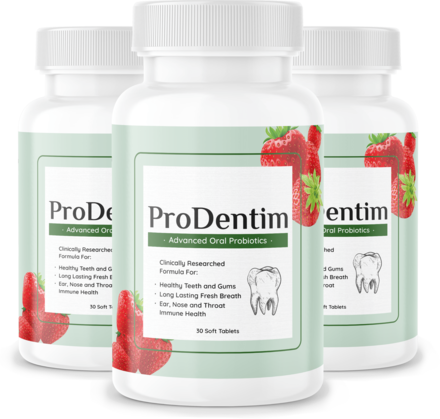
ProDentim
Oral probiotic chewable
Our editorial score.Scored on formulation, refund policy, and value, not on a proven cure.
The best-known oral-probiotic chewable, and a reasonable second choice if you prefer a lozenge.
- 60-day money-back guarantee, which covers the trial period if it does not help
- Chewable format some people stick with more easily than capsules
- Sold through BuyGoods, which processes refunds reliably
No independent trial shows ProDentim reduces gum disease. We rank it just below ProvaDent on formulation, and the 60-day refund window is the only thing that makes a trial reasonable.
ProDentim is a chewable oral-probiotic supplement that lists three probiotic strains and four supporting ingredients. Some of those ingredients have genuine published research behind them; others have weak or indirect evidence; and the finished product as a whole has never been tested in an independent clinical trial. This page walks through what is actually in it and what the honest science shows for each component.
What is in ProDentim: the full list
Based on the official product page, ProDentim contains 3.5 billion CFU of probiotics from three strains, plus a proprietary blend of four supporting ingredients. Precise per-strain CFU breakdowns are not published.
| Ingredient | Category | Claimed purpose |
|---|---|---|
| Lactobacillus paracasei | Probiotic | Gum health, sinus support |
| Bifidobacterium lactis BL-04 | Probiotic | Oral microbiome balance, immune support |
| Lactobacillus reuteri | Probiotic | Inflammation, oral environment |
| Inulin | Prebiotic fiber | Feed beneficial bacteria |
| Malic acid | Organic acid | Surface tooth whiteness |
| Tricalcium phosphate | Mineral | Tooth structural support |
| Peppermint | Herb | Freshness, antimicrobial |
No independent laboratory has published a verified analysis of the finished formula, so exact doses per serving are unknown beyond what the label states.
The probiotic strains: what does the evidence actually say?
Lactobacillus reuteri
This is the strain with the most relevant oral-health evidence. A foundational randomized controlled trial showed that L. reuteri reduced gum bleeding and gingivitis versus placebo in patients with moderate to severe gum disease over two weeks. A broader meta-analysis of oral probiotics identifies L. reuteri as one of the most studied strains in the periodontal literature and the one with the most consistent signal for reducing bleeding on probing.
The honest summary: modest, short-term adjunct benefit. The effect tends to revert after you stop, and it does not replace professional cleaning.
Lactobacillus paracasei
There is some trial evidence here, though it is more limited. A randomized, double-blind, crossover trial of L. paracasei GMNL-143 toothpaste found a significant reduction in gingival index scores versus placebo, and some reduction in Streptococcus mutans in gingival fluid. However, plaque index, halitosis, and most secondary outcomes were not significantly different. The study was small and the duration short. The strain in that trial (GMNL-143) is not the same strain ProDentim uses, so the evidence is suggestive at best, not directly confirmatory.
Bifidobacterium lactis BL-04
BL-04 is a well-characterized probiotic strain with good evidence for immune modulation and upper-respiratory-tract health. The evidence for oral-cavity gum outcomes specifically is thinner. The same meta-analysis notes B. lactis in a few combination studies, but the oral signal is much weaker than for L. reuteri. Including BL-04 is not unreasonable, but calling it a gum-health ingredient oversells what the data shows.
The supporting ingredients: honest evidence review
Inulin
Inulin is a prebiotic fiber, meaning it feeds beneficial bacteria rather than acting as a probiotic itself. It is well-established as a prebiotic in gut health research. In the oral cavity specifically, the evidence is limited: a small clinical study found that inulin mouth rinses had some effect on tongue pH and oral malodor, comparable to sucrose. As a supporting ingredient to help probiotic strains survive and establish, inulin is a reasonable addition. Claims that it dramatically reshapes the oral microbiome are not backed by strong oral-specific trials.
Tricalcium phosphate
Calcium phosphate compounds, including tricalcium phosphate, provide calcium and phosphate ions that are the building blocks of tooth enamel. The research base here is real but important to read carefully. A micro-CT analysis found that functionalized tricalcium phosphate combined with fluoride outperformed fluoride alone for remineralization of enamel subsurface lesions in an in vitro (lab) model. That is meaningful evidence, with one crucial caveat: the studies test tricalcium phosphate in toothpaste applied directly to enamel, not in a swallowed or briefly chewed supplement. Whether the calcium and phosphate in a chewable tablet reach enamel in therapeutically relevant concentrations is a different and unanswered question.
Malic acid
Malic acid is an organic acid found naturally in apples and strawberries. ProDentim describes it as supporting tooth whiteness. A published in vitro comparison of natural whitening agents found that strawberry extracts (which contain malic acid) produced some whitening under laboratory conditions, but significantly less than professional treatments. The mechanism appears to be mild surface astringency rather than true bleaching. The ADA has cautioned that acidic fruits applied repeatedly to teeth can contribute to enamel erosion. The trace amount of malic acid in a single daily chewable is unlikely to cause harm for most people, but the whitening claim rests on very thin evidence for supplemental doses.
Peppermint
Peppermint is the most straightforward ingredient. A published study found that Mentha piperita essential oil reduced S. mutans biofilm and showed synergistic effects with chlorhexidine in laboratory conditions. The active components are menthol and menthone. In a chewable supplement, the primary practical effect is freshening breath. Attributing significant antimicrobial or gum-health effects to peppermint leaf in this format goes beyond what the data supports, but it is a well-tolerated, commonly used oral-health additive.
What is missing from this picture
Two things are absent and matter for honest evaluation.
First, no independent clinical trial of the ProDentim formula as a whole has been published. Every piece of evidence above refers to individual ingredients tested in different forms, concentrations, and delivery methods. A chewable tablet is not the same as a lozenge or a toothpaste, and combining several ingredients does not guarantee the result is additive.
Second, exact dosages are unknown. Without a verified supplement facts panel showing per-strain CFU counts and ingredient weights, it is impossible to assess whether ProDentim contains ingredients at doses comparable to those used in the supporting trials.
Bottom line
ProDentim contains ingredients that are not random. L. reuteri has the most credible adjunct signal in the oral-health literature. L. paracasei has limited but not zero evidence. Inulin is a reasonable prebiotic addition. Tricalcium phosphate has real remineralization research, though in a different form and application method. Malic acid and peppermint are generally safe additions with limited specific evidence at supplement doses.
The honest summary is this: individual ingredients have varying levels of support, delivery and dose are unverified, the finished product has no independent trial, and no supplement cures gum disease or replaces brushing, flossing, and professional cleaning. The 60-day money-back guarantee is the practical protection if you decide to try it.
Related notes
The bottom line
No independent trial shows ProDentim reduces gum disease. We rank it just below ProvaDent on formulation, and the 60-day refund window is the only thing that makes a trial reasonable. If you decide to try one, ProDentim is the option we would pick, mainly because the 60-day money-back guarantee makes a trial risk-free.
Check ProDentim Price for ProDentimFrequently asked questions
What are the ingredients in ProDentim?
ProDentim lists three probiotic strains (Lactobacillus paracasei, Bifidobacterium lactis BL-04, and Lactobacillus reuteri) plus a proprietary blend of inulin, malic acid, tricalcium phosphate, and peppermint. The label claims 3.5 billion CFU total, though precise per-strain counts are not published. No independent clinical trial of the finished product exists.
Does the research support the ingredients in ProDentim?
Some of the individual ingredients have published evidence. L. reuteri has the strongest signal for modest, short-term reductions in gum bleeding when used alongside professional cleaning. L. paracasei has a small number of trials on gingivitis. B. lactis BL-04 has primarily immune and respiratory evidence, not specific oral-cavity evidence. The supporting ingredients (inulin, tricalcium phosphate, malic acid, peppermint) all have some research basis, but in very different forms and concentrations than what appears in this chewable. No study has tested this specific formula.
Is malic acid in ProDentim safe for teeth?
Malic acid is a mild organic acid found naturally in fruits. In small amounts as a food ingredient it is generally recognized as safe. However, research on concentrated malic acid or acidic fruit applied repeatedly to enamel notes a risk of surface erosion. The trace amount in a chewable is unlikely to cause harm for most people, but the whitening evidence for malic acid in supplement form is limited.
Does ProDentim work better than regular brushing and flossing?
No. No probiotic supplement replaces mechanical cleaning. Every relevant probiotic trial studies the supplement as an add-on to brushing, flossing, and professional cleaning, not as a substitute. The improvements seen in trials are modest additions on top of good hygiene, not standalone results.
Is ProDentim FDA approved?
No dietary supplement is FDA approved in the sense that drugs are. The FDA does not evaluate or approve supplement formulas before sale. ProDentim is manufactured in an FDA-registered facility, which is a facility requirement, not product approval. Claims about ingredients must be truthful but are not pre-cleared.
Sources & references
Every claim above is drawn from these primary sources.
- ● Decreased gum bleeding and reduced gingivitis by the probiotic Lactobacillus reuteri · PubMed (National Library of Medicine)
- ● Oral probiotics and periodontal parameters - meta-analysis · PMC (National Library of Medicine)
- ● The impact of Lacticaseibacillus paracasei GMNL-143 toothpaste on gingivitis and oral microbiota in adults · PMC (National Library of Medicine)
- ● Remineralization of enamel subsurface lesions using toothpaste containing tricalcium phosphate and fluoride: an in vitro analysis · PMC (National Library of Medicine)
- ● In vitro comparison of natural tooth-whitening remedies and professional tooth-whitening systems · PMC (National Library of Medicine)
Free checklist
The 12 checks to run on a gum supplement label before you pay for it.
A one-page checklist drawn from ADA, Cochrane Oral Health and NIH/NIDCR guidance, plus the FTC's own rules on supplement advertising. It tells you which label claims mean something, which are decoration, and the wording that signals a product is not worth your money. We send it immediately, then one short note a week.
One click to unsubscribe. We never sell or share your address. Privacy.