Quick answer
Certain oral probiotics reduce bad breath by competing with the anaerobic bacteria that produce volatile sulfur compounds. The strain with the clearest evidence is Streptococcus salivarius K12. The effect is real but modest: individual randomized trials show reductions, but pooled meta-analyses show mixed results, studies are small, and the benefit fades after stopping. Tongue brushing does more, and combining it with a K12 probiotic outperforms either alone.
- S. salivarius K12 has the most clinical signal for halitosis, secreting bacteriocins that inhibit odor-producing anaerobes
- The evidence is encouraging but limited: positive individual trials, but mixed pooled results and short follow-up
- The benefit is maintenance-dependent and reverts after stopping; tongue brushing remains the higher-value first step
Short on time? Our pick
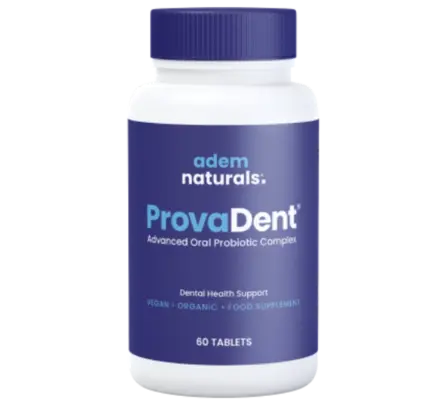
ProvaDent
Oral probiotic support
Our editorial score.Scored on formulation, refund policy, and value, not on a proven cure. No gum-disease supplement is clinically proven.
The oral-health supplement we'd try first, if we were going to try one.
- 60-day money-back guarantee, which covers the trial period if it does not help
- Sold through BuyGoods, which processes refunds reliably
- Aimed at the oral microbiome, the current focus of gum-health research
No supplement is proven to cure gum disease or regrow bone. We highlight ProvaDent for its formulation and guarantee, not as a cure.
Can probiotics reduce bad breath? The honest answer is yes, a little, and only as an add-on to good oral hygiene. A handful of randomized controlled trials show that specific oral probiotic strains, especially Streptococcus salivarius K12, reduce volatile sulfur compound levels in people with halitosis. The effect is real but modest, short-lived once you stop, and dwarfed by the impact of tongue brushing and consistent hygiene. This page explains the mechanism, the actual evidence, and what a realistic expectation looks like.
The short answer
Certain oral probiotics reduce bad breath by competing with the anaerobic bacteria that produce volatile sulfur compounds (VSCs), the chemicals responsible for the characteristic rotten-egg and sulfurous odors of halitosis. The strain with the clearest signal is Streptococcus salivarius K12. The evidence is encouraging but limited: studies are small, follow-up periods are short, and a 2021 systematic review found that the pooled effect across trials did not reach statistical significance. Individual trials are more positive, which tells you the effect exists but is modest and variable.
Where bad breath actually comes from
Most bad breath originates in the mouth, not the stomach, a point worth stating plainly because a lot of probiotic marketing conflates gut health with oral malodor.
The primary culprits are anaerobic gram-negative bacteria that colonize the back of the tongue, the gum pockets, and between the teeth. When these bacteria break down proteins and amino acids from saliva, food, and dead cells, they release volatile sulfur compounds: hydrogen sulfide (H2S), methyl mercaptan, and dimethyl sulfide. Hydrogen sulfide is the most common; methyl mercaptan is more strongly associated with gum disease.
The single most effective intervention for tongue-origin halitosis is mechanical: tongue brushing or scraping removes the coating where these anaerobes thrive. Brushing, flossing, and treating any underlying periodontal disease matter more than any supplement. That is the baseline. Probiotics, if they help at all, sit on top of that baseline.
The proposed mechanism: competing with odor producers
Oral probiotics are theorized to reduce halitosis through three overlapping routes.
First, competitive exclusion. A beneficial strain colonizes the tongue and oral surfaces, physically crowding out odor-producing anaerobes by competing for the same binding sites and nutrients. Second, bacteriocin production. Streptococcus salivarius K12 secretes small antimicrobial compounds called bacteriocins that inhibit the growth of target bacteria, reducing their population below the threshold where they produce significant VSCs. Third, immune modulation: shifting the oral environment in ways less favorable to pathogenic anaerobes, though this route is the least well-characterized.
A 2024 review in Frontiers in Microbiology noted that K12 and M18 strains of S. salivarius produce bacteriocins with demonstrated inhibitory activity against VSC-producing bacteria, while cautioning that evidence for finished oral health products is often strain-specific and that many products lack clinical validation beyond general strain history.
What the trials actually found
| Outcome | Evidence summary |
|---|---|
| Reduction in VSC levels | Positive in most individual RCTs; pooled meta-analysis not significant |
| Organoleptic scores (smell test) | Modest improvement in several trials |
| Tongue coating | Some reduction, especially with combined probiotic-plus-tongue-brushing |
| Duration after stopping | Benefit tends to revert; rebound seen in follow-up phases |
| Gut probiotics for oral halitosis | No meaningful evidence |
A 2026 randomized controlled trial of 80 participants found that S. salivarius K12 alone reduced VSC levels during an 8-week study (4 weeks of treatment, 4 weeks of follow-up), tongue brushing alone also reduced VSCs, and the combination of both produced the greatest and most sustained reduction. That last point is important: the probiotic amplified the effect of a hygiene intervention, rather than replacing it.
An earlier randomized trial in children tested chlorhexidine pretreatment followed by S. salivarius K12. Children who received the full sequence showed stable improvement in halitosis scores at follow-up, while those who received chlorhexidine alone saw benefits that faded. The authors concluded that probiotic therapy following oral disinfection may reduce halitosis severity over longer periods.
A systematic review and meta-analysis published in Frontiers in Nutrition that pooled four randomized studies found that while individual trials showed promise for S. salivarius K12 and Weissella cibaria, the pooled analysis did not reach statistical significance (p = 0.53). The authors concluded that “some probiotics appear to have a beneficial effect on halitosis of oral origin” but that more robust trials are needed. A more recent systematic review of six trials covering 360 participants was more positive, finding that probiotics significantly reduced VSC levels and improved organoleptic scores, while cautioning that heterogeneity and short follow-up periods limit clinical translation.
Why “modest” is the right framing
Three structural problems keep this evidence below the level of strong.
The studies are small. Most trials enroll under 100 participants, and the variation in strain, delivery format (lozenge, tablet, chewing gum), and outcome measure makes pooling difficult.
The strains matter enormously. A gut-targeted Lactobacillus acidophilus capsule does nothing for oral halitosis. The evidence is largely strain-specific to K12, M18, and a handful of others. Most “oral probiotic” products on the market have not been tested for halitosis in their finished formulation.
The benefit is temporary. The introduced bacteria do not permanently colonize the mouth. Studies tracking people after they stopped taking the product found that VSC levels tended to rebound. This means any benefit is maintenance-dependent: you would need to keep taking the product to keep whatever modest effect it provides. That ongoing cost is worth accounting for before committing to a product.
Who might actually see a benefit
Oral probiotics make the most sense as a secondary add-on for people who already have a consistent oral hygiene routine and still experience mild to moderate halitosis. If you have not tried daily tongue brushing, that is the higher-value step to take first, and the 2026 trial suggests combining both is more effective than either alone.
If halitosis is severe, persistent, or tied to gum pockets or inflamed tissue, a dental visit matters more than any supplement. Probiotics do not treat periodontal disease, and halitosis rooted in deep pockets requires professional care.
For non-oral halitosis, which has a gastrointestinal or systemic cause, oral probiotics have no logical mechanism and no evidence of benefit.
Bottom line
Probiotics for bad breath are a legitimate area of research, not pure marketing. The mechanism is biologically coherent: certain oral strains compete with VSC-producing anaerobes and secrete bacteriocins that limit those bacteria’s activity. The strain with the most consistent signal is S. salivarius K12. The evidence is encouraging but not definitive: individual trials are positive, but pooled analyses show mixed results, study sizes are small, and the benefit fades after stopping. Tongue brushing is a higher-value intervention that costs almost nothing; combining it with an oral probiotic appears to outperform either alone, at least in the short term. If you decide to try one, choose a product with a money-back guarantee so the experiment is low-risk, and keep your expectations realistic.
Related notes
The bottom line
No supplement is proven to cure gum disease or regrow bone. We highlight ProvaDent for its formulation and guarantee, not as a cure. If you decide to try one, ProvaDent is the option we would pick, mainly because the 60-day money-back guarantee makes a trial risk-free.
Check Latest Price for ProvaDentFrequently asked questions
Do probiotics actually reduce bad breath?
Yes, modestly. Several randomized trials show that certain oral probiotic strains, particularly Streptococcus salivarius K12, reduce volatile sulfur compound levels and organoleptic scores in people with halitosis. The effect is real but small, inconsistent across studies, and tends to revert after stopping. Mechanical hygiene (tongue brushing, brushing, and flossing) does more.
Which probiotic strain works best for bad breath?
Streptococcus salivarius K12 has the most clinical signal for halitosis. It works by colonizing the tongue and competing with odor-producing anaerobes, and by secreting bacteriocins that inhibit those bacteria. Weissella cibaria CMU has also shown signal in small trials. Gut-targeted strains (standard Lactobacillus supplements) have no meaningful effect on oral bad breath.
How long does the probiotic effect on bad breath last?
Studies follow participants for up to 12 weeks, and the benefit appears to fade when the product is stopped. The introduced bacteria do not permanently colonize the mouth, so the reduction in volatile sulfur compounds is maintenance-dependent. One study showed rebound of VSC levels during a post-intervention follow-up period, though the combined probiotic-plus-tongue-brushing group fared better.
Can an oral probiotic replace brushing and tongue scraping for bad breath?
No. Trials test probiotics as an addition to hygiene, not a substitute for it. Mechanical cleaning, especially tongue brushing, removes the coating where anaerobic bacteria thrive. A 2026 randomized trial found the combination of tongue brushing plus S. salivarius K12 outperformed either alone. The probiotic is an adjunct, not a replacement.
Are gut probiotics useful for bad breath?
Rarely, unless the halitosis has a non-oral source (gastrointestinal reflux, systemic causes). The vast majority of bad breath originates in the mouth, especially on the back of the tongue. For oral-origin halitosis, you need an orally delivered probiotic that colonizes the mouth, not a gut capsule that never reaches the oral cavity.
Sources & references
Every claim above is drawn from these primary sources.
- ● Tongue brushing and oral probiotics for the treatment of halitosis: a randomized controlled trial · PubMed (National Library of Medicine)
- ● Chlorhexidine pretreatment followed by Streptococcus salivarius K12 on halitosis in children: a randomised controlled clinical trial · PubMed (National Library of Medicine)
- ● Role of Probiotics in Halitosis of Oral Origin: A Systematic Review and Meta-Analysis · Frontiers in Nutrition
- ● Probiotics significantly reduce VSC levels and improve oral malodor: systematic review · PMC (National Library of Medicine)
- ● Probiotics for oral health: a critical evaluation of bacterial strains (2024) · Frontiers in Microbiology
Free checklist
The 12 checks to run on a gum supplement label before you pay for it.
A one-page checklist drawn from ADA, Cochrane Oral Health and NIH/NIDCR guidance, plus the FTC's own rules on supplement advertising. It tells you which label claims mean something, which are decoration, and the wording that signals a product is not worth your money. We send it immediately, then one short note a week.
One click to unsubscribe. We never sell or share your address. Privacy.